Showing posts with label europe. Show all posts

17 April 2012

A Second Chance at the Chestnut of 100 Horses

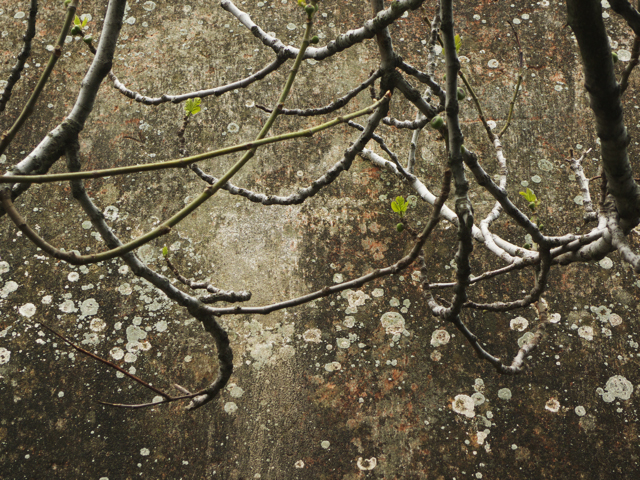
 Fig and Lichens
 
In September of 2010 I visited the Castagno dei 100 Cavalli for the first time. It was the height of Mediterranean summer, over-ripe, really, and the Castagno was no exception. Its half-dome canopy was so heavy with foliage and chestnuts that one could barely see the branches for the leaves. I made some photos, but came away thinking the umami of it (I like to keep my mixed metaphors vegetarian friendly) was somewhere underneath that surface: while the lush growth was impressive, it is the structure of its split-and-spread trunk that really tells the story of what it's like to be alive for 3,000 years. 

Moss on the Castagno, 2012

Since I was returning to Europe to install my exhibition at the Staatliche Kunsthalle Baden-Baden, I took a cue from the death of the Senator Tree earlier this year, and decided to seize this opportunity to return to the Castagno. Spring was well underway in the tree-lined streets of that southern German town last week. Their chestnuts were already well-leafed, and I worried that I had come all this way just to face the same obfuscation. But I had forgotten an all important factor: it's not just latitude that matters; altitude can make a world of difference.

 Hail and Lava
 
I arrived in Sant'Alfio in the dark. I drove my rented Smart Car through the narrow, steep-walled switchbacks and up (then back down) an unsigned one-way street. Once safely tucked in at my favorite agroturismo, a thunderstorm settled in, then hail pelted down in loud, if brief, intervals, stirring up the yard dogs. In the morning, a layer of perfectly round hail covered the previous layer of lava spit down from Mount Etna. 


By the time I had made my way over to the Castagno, the hail had already melted, but I could see it had knocked a few tender leaves from its branches. The high altitude slows the coming of spring (and it's not hard to believe that its unseasonably cold here, as I write under a blanket in an old stone farm building.) I welled up with tears at the sight of its bare branches flecked with green, at the beauty of its form...and in relief for not having come all this way for naught. 


The weather changed every few minutes, clouds rolling in and just as soon rolling right out again. I explored the perimeter and the adjacent hazelnut orchard with my cameras. This morning I returned once more to meet Alfio, a gate keeper of the tree here in Sant'Alfio, whom had kindly held an umbrella over my head in 2010 while I photographed through our first meeting. The clouds persisted, but the precipitation did not, and I was able to see much more this time than last. I saw the heavy sections of the trunk and new suckers pushing forth, connected below the surface by a massive root system. I saw the details of gnarled and moss-covered swirls of bark. And I saw the deep charcoal of one section that I had overlooked before:


"Fire," I asked? Yes. Someone had tried to grill sausages inside the tree, and had nearly burnt it down. The fence has been up ever since.


28 September 2010

The Ancient Olive of Ano Vouves

[Olive tree of Ano Vouves, approx. 3,000-years-old (unconfirmed)]

I find I've been talking about "time flying" a lot lately. A blink (and a 19-hour travel day) later, and I'm back home in Brooklyn. It's amazing how 30 days on the road and crossing 7 time zones requires so much recalibration. It feels significant in the realm of personal time, but what happens when pondering the loose fragment of a second taken to capture an image of 4,000 years of growth? Even if we don't think back quite that far, the question remains - what did it feel like when it took months to get from that village in Crete all the way to New York City? Or years? Or how about when the continents weren't even known to each other? To us, it is always now...and now seems to be getting faster and faster. So I wonder: If context shapes our understanding and experience of time, are we therefore temporal relativists?                                                                                                                                     
Ok. I'll stop waxing philosphic for the moment and leave you with this picture of the venerable old tree, holding court in upper Vouves. Stay tuned for the 1,000 words later.

19 September 2010

Posidonia Oceanica

It's amazing how time can fly by on the road. It seems that one minute I was still trying to gain more intimate access to the Castagno dei 100 Cavalli (which I did, albeit in the rain), and in the blink of an eye it's already my last day in Spain. 

In the past week I made four dives to different sites where the Posidonia Oceanica grows, the image here a rather shallow shot, showing off the beautiful color of the grass, and hinting at the expansive meadow. The grass extends all the way from Ibiza to Formentera, and was designated as a UNESCO world heritage site, even before its exceptional age was discovered. 

It was really interesting to watch the biologists at work, hear about the accidental discovery of the clone grass (analysis of the genome of shoots from well-separated plots proved identical), and to hear about the vital role of the meadow in the ecosystem - as well as the invasive species of algae that now endanger it. More details on all of this to come, and in the mean time, see them below, counting shoots of grass in special plots which they've been returning to for the past 10 years.

Tomorrow it's off to Crete, in search of what very well might be the world's oldest Olive tree.

09 September 2010

A tough (chest)nut to crack


PLAN B 
It's proving a bit tricky to get accurate information on the age of the tree, or to even get through the gate for that matter. (No, that rope fence isn't holding me back - I'm still relegated to the outer circle of the high metal fence. I stuck my camera through the slats, my arms separated by a post, to get this shot.)

I've gotten a small taste of Italian bureaucracy in trying to gain access and information, but it's been tempered by one of the most helpful people I've yet to meet on my travels. Valentina, jack of all trades at the agroturisomo, sat and made call after call for me this morning, speaking in rapid Italian to scientists in Catania and Florence. The first, it turned out, was an entomologist. He passed along the information for someone he said was an expert on the tree. When we got her on the phone, she told that she would study the tree, except she's not all that interested in forestry. She passed along the name of another 'expert,' this one who was at least offer up the information that there is a book on the subject. Which brought us full circle back to the first call Valentina made, to Sant'Alfio City Hall. Someone will be coming up to meet us here this afternoon, perhaps with book in hand. And then we'll set out together to find the traffic carabinieri to open the gate.

Fingers crossed. 

08 September 2010

Buongiorno Castagno


First look, Castagno dei 100 Cavali (5 exposures)

It's my second morning here in Sicily. Another overcast day, but that's my favorite shooting weather.  After settling in yesterday, I went directly to the Castagno dei 100 Cavali. It seems to be quite happy, large and green and heavy with the season's chestnuts. Today I'm trying to find out how to breach the protective fence which encircles it. I've just been instructed to find the traffic police in the town square -two women in a white car - and ask them to let me in.

I arrived here in Sant'Alfio yesterday afternoon, after a somewhat harrowing drive from Catania, where I had flown in the night before. Street signs, traffic lanes, signals - who needs 'em? Scooters and motorcycles whip by from all directions, pedestrians cross whenever and where ever they see fit, cars push their way towards/into/in front of wherever they're trying to go. One out of five streets seems to have a sign. I laughed aloud while driving up a busy, narrow two-lane street, the scooters scooting comfortably into the oncoming traffic... suddenly joined by an older woman in a motorized chair, wheeling her way up the street as a bus barreled towards them all from the opposite direction. No one seemed to find this unusual except me. 

Good thing I'm not a nervous driver.

And from that frenetic drive in Catania into the country-stillness of Sant'Alfio. It's quiet and peaceful here, birds breaking the near-silence amidst olive, apple, fig and plum trees that dot the still-working farm and one-time monastery where I'm staying. The farm dogs were kind enough to give me a walking tour when I arrived.

And on that note, it's time to get off the computer and back to the tree.  Oh, and feel free to check in on my Flickr stream, where I'm posting more images from my trip.

Ciao for now...


04 September 2009

9,500-year-old clonal spruce

Get ready: I'm heading to Sweden on Sept 14th to find and photograph a 9,500-year-old clonal Spruce tree.

20 August 2007

SIBERIAN BACTERIA IN COPENHAGEN

WEEK 8: INTO THE LAB

so there i was. the last stop on my trip, and my first time doing artwork in a biology lab. i was meeting with martin bay hebsgaard, a PhD candidate in ancient DNA and evolution at the niels bohr institute at the university of copenhagen. i was put in touch with martin by sarah stewart johnson, a PhD candidate in planetary science at MIT, and a primary researcher on the siberian bacteria. working with eske willerslev, director of the ancient DNA group, sarah's research is about to be published by the proceedings of the national academy of sciences. their remarkable findings show that the bacteria were not lying dormant in the permafrost, but rather showed continuous DNA repair -- an indication that these ancient cells have been continuously living. for how long?

folks, we have a winner. 400,000 to 600,000 years.


these findings are particularly interesting to sarah,
who is working on a dissertation entitled "mars in the late noachian: evolution of a habitable surface environment." her findings here on earth raise the point that similar discoveries of viable ancient life are possible on mars or europa (one of jupiter's moons) if ever such life did in fact exist there. um...wow.

but back to the earth. first stop, the freezer. it was packed with soil samples from canada, hungary, and siberia. i only needed a small quantity to view under the microscope, so we headed into the clean lab (kept clean with UV light and positive air pressure) in our white safety suits.

yep. that's yours truly.

it was hot as all get-out in there, so thankfully i could do the actual work en plein air. well, outside of the suit, at least. martin carefully transfered a small amount of the soil into another container, which we would take with us to a different building to take a look under the microscope. henirk glenner, a colleague of martin's, allowed me to use his digital imaging setup to photograph. it works like a regular microscope -- we prepared slides, adjusted the magnification, focus, and light -- the only difference being that a specialized digital imaging component is attached both to the microscope and a computer. an imaging application allows you to see what's under the microscope on the screen, make exposure adjustments, and then capture the image. i was transfixed for days, changing views and settings and magnifications.

the research done on this bacteria (class: actinobacteria, many within the order micrococcaceae and genus arthrobacter ) was not done visually, so i likely produced some of the first images of it -- or at least where it lives. it was difficult to tell what i was looking at, and i probably needed magnification powers beyond what was available. not to mention the question of how long the bacteria can survive at room temperature. so i created images according to my own aesthetic choices within the given scientific parameters, leaving some questions unanswered.

it was a thrilling last stop on a truly eye-opening trip.

oh, and i want a microscope.

12 August 2007

WEEKS 6 & 7: I SEE SCOTLAND, I SEE FRANCE

AUG 5: EDINBURGH (PT. 1)
i arrived in edinburgh in the late afternoon in the rain, returned my rental car, and headed to the center of town where i would meet a group of students from rollins college (where i will give a lecture on this project in september) lead by friend (not to mention professor and talented artist) rachel simmons. (check out rachel's blog for an alternate account of the next few days.) the fringe festival was in full tilt, and the city was buzzing with activity, the locals having long since split town. i slept with ear plugs to muffle an event in an adjacent building which raved on into the wee hours of the morning.

AUG 6: GLASGOW'S HUNTERIAN & THE FOSSIL GROVE
what seemed like mere hours after arriving in ediburgh, rachel and i hopped a train to glasgow. at this point in my travels i was starting to wing it when it came to the small stuff. (looking up directions ahead of time, checking for opening hours, for instance.) travel fatigue was setting in, combated only by my desire not to miss opportunities. i had been looking forward to visiting the fossil grove since i left new york, so that was first up on the day's loose agenda. after getting some completely incomprehensible directions from a scotish bus driver, we finally got to the bus station, chose a stop, and found a less heavily accented local to point us in the right direction.

the fossil grove is fantastic, and unlike anything i'd ever seen. the fossils are the remains of an ancient forest, around 330 million years old. unlike petrified forests, which are formed from the actual wood of the trees (growth rings ofter still in tact), these fossils are actually casts of their former selves, capturing the broken down wood (and other materials that would have entered the stumps) in fossil form, the bark long since broken away. the resulting forms looks more like clay sculptures than wood or rock.

next up was the hunterian museum, where we would meet with jim devine, head of multimedia at the museum and a friend of our friend (and talented artist) diana folsom. there were stuffed pigs with two heads and stuffed deer with two bodies and a single head. there were geological samples and explicit illustrations of the birth of gynecology. it was sort of a natural history museum greatest hits by way of ripley's believe it or not. (oddly enough, my hotel in copenhagen is next store to the danish ripley's. i haven't been in.) though there was something resonant here as well -- it was interesting to think of the oddities in terms of chance and anomaly -- they have that in common with the OLTW.

so the day was lousy with interesting things. i was pretty sure i was reaching my saturation point, however, when i looked out at a panoramic view of glasgow trying to reconcile some missing landmarks in the landscape -- until i realized i was, ahem, looking for landmarks in edinburgh. (the following week i would awake with a start on a plane to copenhagen, certain for a moment that i was in the back of a car in france.)

AUG 7-9: EDINBURGH (PT. 2)
but back to edinburgh it was. on the 7th we visited the large and pristine botanical garden, where i was happily surprised to see they had a william eggelston exhibition up. the following day was a hike up arthur's seat, a little highland landscape located within the bounds of the city. disinterested in a long walk around it's base to the gently sloping incline, rachel and i decided on a more adventurous route. after passing through a depression filled with some pot-smoking men, we scaled a cliff-like side, the weight of my ever-heavy camera bag strategically leaning forward as not to send me tumbling back down. we made it up (and back) uninjured. i'll have to take in the northern highlands next time. now it was time for france.

AUG 9 - 16: THE SOUTH OF FRANCE & A LITTLE SPAIN, TOO
a little time off couldn't have come at a better time. i won't bore you with the details, but suffice it to say that i swam in rivers, pools, and the ocean, hiked, biked, and ran, and ho mangiato molto bene. (yes, i know, that's italian.) as for other entertainments, leave it to the french to come up with the world championships of espadrille-kicking. contestants run up to the starting line, an espadrille perched on their kicking foot, and let 'er rip. surprisingly you don't seem to get points for flair, it's all about distance. the current world champ is measuring in at 25 meters. not bad.

DEATH IN THE AFTERNOON
but not all amusements are such fun and games. i also attended my first ever bull fight in bayonne. it was a first for the matadors, too -- it was a novillada, the first time they would fight the bulls publicly in the ring, not to mention all the way through to the death blows.

this was a complex experience, from deciding to attend in the first place all the way through the post-fight discussions. i'm going to have to save this one for a separate posting -- it warrants exploring.

ART IN THE AFTERNOON
since i was a hop, skip and jump from northern spain it seemed downright silly not to take in the guggenheim bilbao. while all the controversy about gehry's involvement in the ratner development in brooklyn has put me off of him (not to the point that i'm wearing a "fuck frank gehry " tshirt, mind you), i have to admit that the guggenheim is worth its salt. (and if you know my feelings about salt you know that i wouldn't say that lightly.) my highest compliments go to how the space compliments the richard serra work. if fact i've never seen it done better. (sorry MoMA, dia, gagosian.) the monumental anselm keefer's also seemed right at home. not surprisingly i was particularly taken by keefer's works incorporating star maps and "the secret life of plants."

it's remarkable that some art and architecture managed to put an old ship building town on the world map.

NEXT UP
the last stop (!) on this OLTW trip: siberian bacteria in copenhagen.

THE FORTINGALL YEW

i arrived in scotland as the sun went down. it was after 10 pm and all the customs officials had already called it a night, so i headed right to the rental car desk. by this point driving on the left side of the road didn't require a second thought, though driving in the poorly-signed streets of edinburgh without a navigator to read my google directions did prove a bit tricky. i did manage to stay on track, however, after a quick check-in with the A to Z at a petrol station. the next morning i drove out of edinburgh towards perthshire. with something that i have to attribute to good travel karma, when i arrived in aberfeldy (the town where i was staying) i somehow managed to coast right up to the street i was looking for, just as i was going to have to consult a map or a local. after settling in i continued my drive to the even smaller village of fortingall. in a second stroke of luck, i had an entire precipitation-free afternoon to photograph. rain set in later that night and didn't stop until i was back in edinburgh.

the fortingall yew (yes: yews are conifers, ewes are female sheep), somewhere between 2000 and 5000 years old (probably closer to the former than the latter), lives within the confines of a churchyard, further confined by its own tourist-proof stone wall. the area is steeped in history, not to mention incredibly beautiful, so its popularity is hardly surprising. however, the increase in traffic lead to substantial souvenir-taking of the yew's bark, endangering the health of the tree. hence the wall.

while it seems to be undisputed that the fortingall yew is the oldest tree in europe, this was another case of shoot first, ask questions later -- i'll have to confirm the age and history of the tree with the appropriate experts after i return from this trip. after the lengths required to reach and research the baobabs and welwitchia, reaching the yew was much closer to a walk in the park.